Lately, I’ve had time on my hands to literally dig into things. Taking care of my tropical outdoor plants has become part of my daily routine. Luckily, these heat-and-humidity-tolerant plantings have a tendency to grow relatively fine on their own without much help on my part. This is probably a good thing.
I’ve also been sifting through weathered black-and-white photos of my family homestead. There are countless snapshots of the farmhouse’s wrap-around porch, seemingly full of all things begonia, fuchsia, and nasturtium, to name a few.
Across the road from that house, many years after my grandmother passed, my mother and I would find massive amounts of beautiful, delicate, and incredibly fragrant pink and red roses scattered throughout the roadside weeds. My mom told me that when she was young, grandma would toss her old rose clippings to the other side of the road. I suppose mulching wasn’t much of a big deal back in those days.
Somehow, these beauties managed to re-emerge from virtually no tender loving care, no fertilizer—and probably despite some county road worker’s pesticide applications—unscathed and stunning. It was almost as if they had been tended to with the utmost of gardening love.
When I was growing up, my mom and I would also go down the hill past grandma’s discarded rose bushes, and walk through a field where one of the original area homesteads once stood. Good indicators that there used to be an old homestead in fields like this are fruit trees and domestic flowers, the latter of which, not unlike my grandmother’s long-abandoned roses, would somehow return each spring. Daffodils and narcissus, crocus and tulips–what stories their forebearers might be able to tell?
While I admire the gardening skills of the women in my family before me, I have to admit, I always thought those talents somehow managed to elude me. That was, until the smarts of some unwitting horticulture students at Cornell University came into play, some thirty-five years ago.
As the wife of a Cornell agricultural grad student, each spring my husband would bring all sorts of flowers home–class experiments that undergrads tossed away into greenhouse dumpsters at semester’s end. Fortunately, these “Frankenplants” saw new life, thanks to my husband’s last-minute salvage efforts. They also allowed me the chance to try my hand (or green thumb) at gardening, just like my mom and grandmother did all those years ago. As a mother of a toddler with ample time to spare, I literally dug into the task and replanted the most incredible show of unnamed varieties of pansies, snapdragons, carnations and more—and they somehow managed to thrive!
Since then, most places I’ve lived have been hot, humid, and generally not terribly hospitable to delicate northern climate plantings. However, there’s something to be said about the resilience of flora in any climate that, while long-abandoned, discarded or forgotten, somehow resurrect their beauty and wonder for generations to come. Perhaps they’re harbingers of a better spring for all of us.
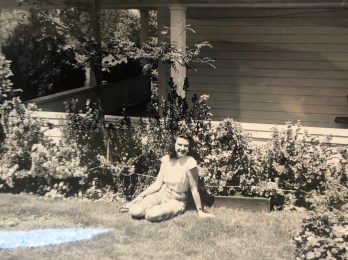
My mom, Vivian Gorzelancyk, porchside late 1930s.
 VivEvents